Dreamcatchers: Origin and Meaning

Quick summary
- Origins: The dreamcatcher (Asabikeshiinh) originates from the Ojibwe and Lakota peoples.
- Legend: Inspired by the Spider Woman (Asibikaashi), protector of children and families.
- Symbolism: The canvas filters thoughts, holding back nightmares to allow only positive visions to pass through the feathers.
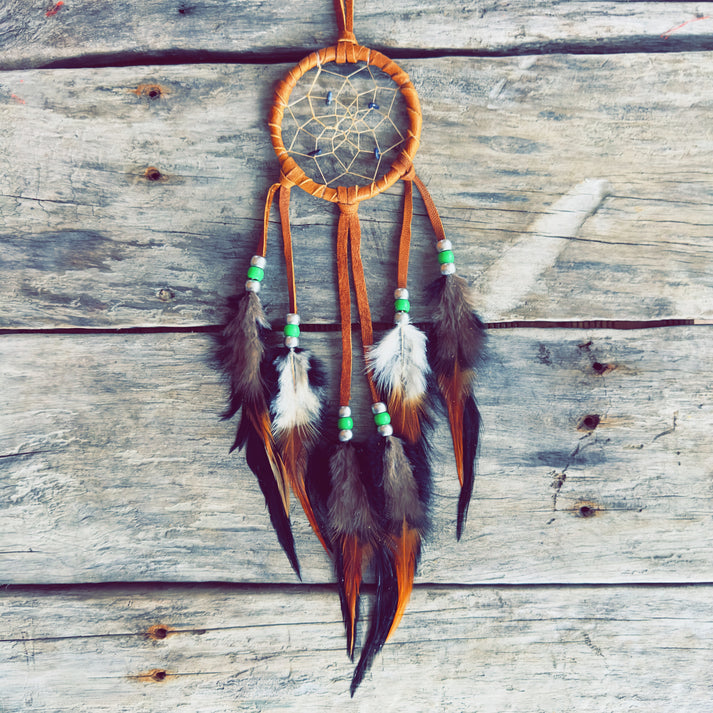
- Components: Each element, from the willow hoop to the central beads, represents the circle of life and the center of the Great Mystery.
The dreamcatcher, also known as a dream catcher, is one of the most iconic symbols of Indigenous craftsmanship. Far more than a decorative object, it carries a profound spiritual dimension. Its structure, materials, and weaving are imbued with meaning and rooted in Indigenous traditions of North America.
1. The origin of dreamcatchers
Dreamcatchers originated in North American Indigenous traditions, where they were designed as protective objects, particularly for children. According to the stories passed down, bad dreams were caught in the weaving, while good dreams passed through the center and followed the feathers.
Traditionally, they were hung above beds or cribs, acting as a reassuring presence linked to rest and inner peace.
2. The symbolism of the dreamcatcher
Each element of the dreamcatcher has a meaning. The circle represents the cycle of life and continuity. The central weave evokes the web of existence, while the feathers symbolize lightness, breath, and the connection between the earthly and spiritual worlds.
The added pearls or stones can represent symbolic markers, linked to protection, memory or the intention given to the piece.
3. Handcrafted production and respect for materials
Crafting a dreamcatcher is a traditional art that requires patience and respect. Natural materials such as leather, wood, and feathers are carefully selected. Each piece is handmade, without industrial production, making it a unique work of art.
Choosing a handcrafted dreamcatcher supports a living craft and an approach that respects life and traditions.
4. The spiritual dimension
In many Indigenous cultures, dreams are seen as spaces for transmission and inner reflection. The dreamcatcher supports this dimension by fostering a state of calm and receptivity.
Hanging a dreamcatcher can also be seen as a symbolic gesture, a reminder of the importance of rest, introspection and balance.
5. Dreamcatchers today
Today, dreamcatchers are found in many homes. However, their global popularity makes it essential to choose authentic pieces, made by indigenous artisans, respecting traditions and materials.
An authentic dreamcatcher retains its symbolic and handcrafted significance, far removed from standardized objects.
6. Where to find authentic dreamcatchers
To respect the origin and meaning of the dreamcatcher, it is important to support identified Indigenous artisans. The boutique artisanatautochtone.com offers dreamcatchers handcrafted from natural materials, using a clear artisanal approach.
7. Installation and maintenance advice
- Place the dreamcatcher near the bed or in a resting area.
- Let natural light reach it gently over the course of several days.
- Dust gently with a dry cloth or a duster.
For example, 3-inch dreamcatchers offer a discreet presence ideal for small spaces, while 8-inch dreamcatchers allow you to fully appreciate the complexity of the weaving.
Conclusion
The dreamcatcher is a symbol of protection, rest, and connection to the living world. Understanding its meaning and choosing a piece made according to tradition allows us to fully honor this meaningful object.
Additional articles
- How dreamcatchers work and their meaning
- Where to place a dreamcatcher
- Myth or reality surrounding dreamcatchers
Bearing the wisdom of dreams
Handcrafted creations made by Dave Verreault-Thisselmagan, an Ilnu craftsman.